

Life as an RPG: Think Like a Player to Level Up

Anyone who has stayed up all night for an expansion launch knows what it is like to have energy to spare for something that matters. The question of this guide is simple: what if that same courage were pointed at your dreams? Thinking like an RPG player is not escaping reality. It is using a language you already speak to organize your life.
What is the RPG mindset?
It is a way of looking at your own life through the lens of a role-playing game:
- You are a character in progress, not a "finished" or "broken" person.
- There is a campaign: a big goal that organizes your choices.
- The road is made of small quests you can finish today.
- Big obstacles are bosses: you face them in phases, prepared.
- You do not play alone: there is a party, mentors and allies.
- Rest and recovery are part of the game, not weakness.
This mindset is related to gamification (using game elements outside games, per Deterding et al., 2011), but it predates any app: it is a way of thinking. For the practical side of building points and rules, see the complete guide to gamifying your life.
Why does it help you level up?
There is no proof that "thinking like a player" solves problems by itself, and this guide does not promise that. What psychology research offers are clues about why game logic tends to motivate.
1. Mastery is built by doing. According to self-efficacy theory, confidence that you can do something comes mainly from experiences where you actually do it and succeed, called performance accomplishments (Bandura, 1977). An RPG is a sequence of small wins with rising difficulty: exactly that design.
2. Clear, challenging goals direct effort. Goal-setting theory, summarized after 35 years of research, indicates that specific, difficult goals tend to produce higher performance than vague ones (Locke and Latham, 2002). Every RPG quest is specific.
3. Competence, autonomy and relatedness. Self-determination theory proposes these three needs as the base of healthier motivation (Ryan and Deci, 2000). Leveling up gives competence; choosing your class and quests gives autonomy; the party gives relatedness.
Your character: stats, class and identity
In every RPG you start by creating a character. In life, the equivalent is asking: who do I want to become?
Stats = areas of life
Strength, intelligence, agility and luck map onto what you cultivate: body, mind, relationships, work, money, faith or leisure. Pick four or five areas and give each an honest score, no drama. The point is knowing where to spend your stat points.
Class = the role you choose to play
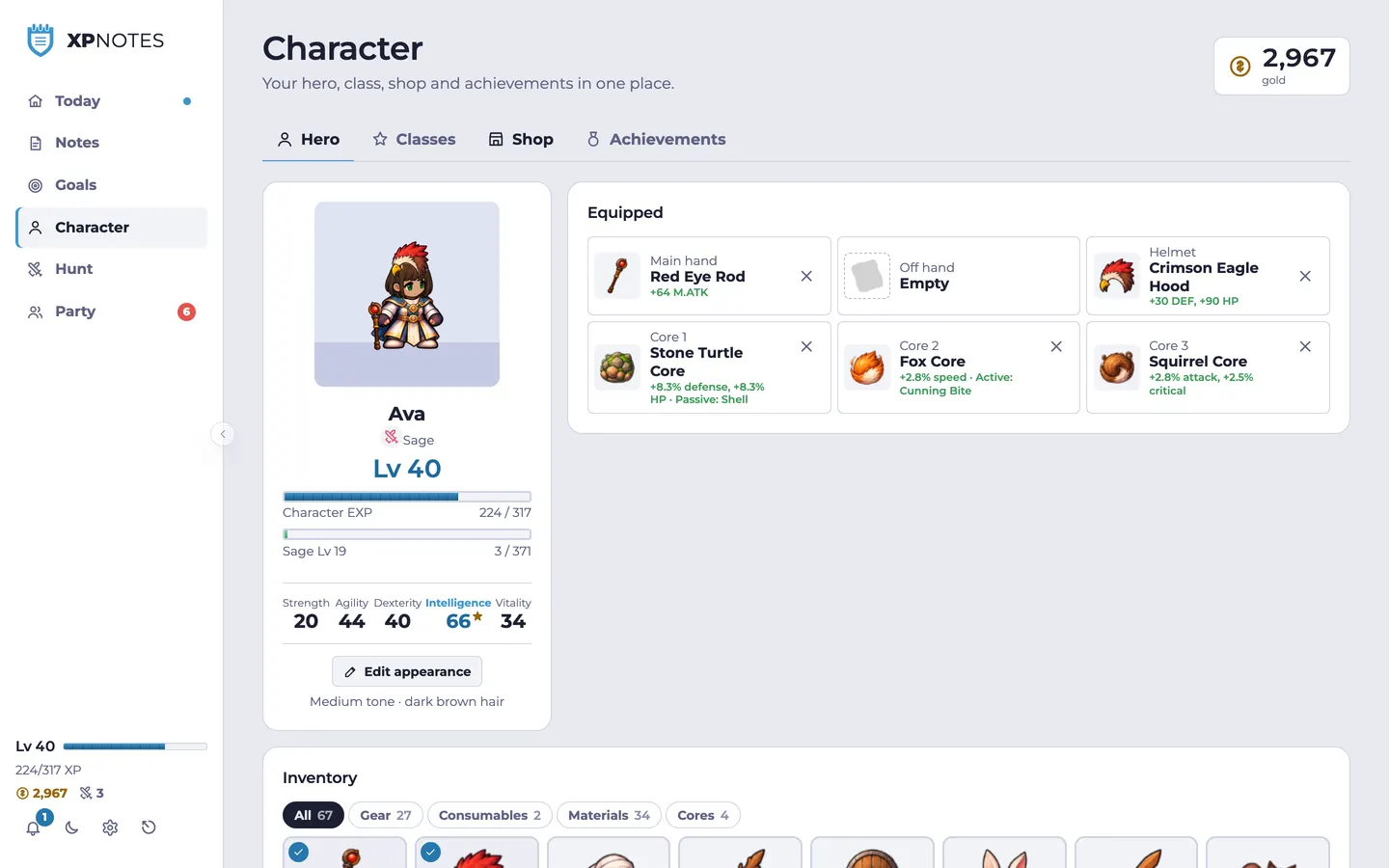
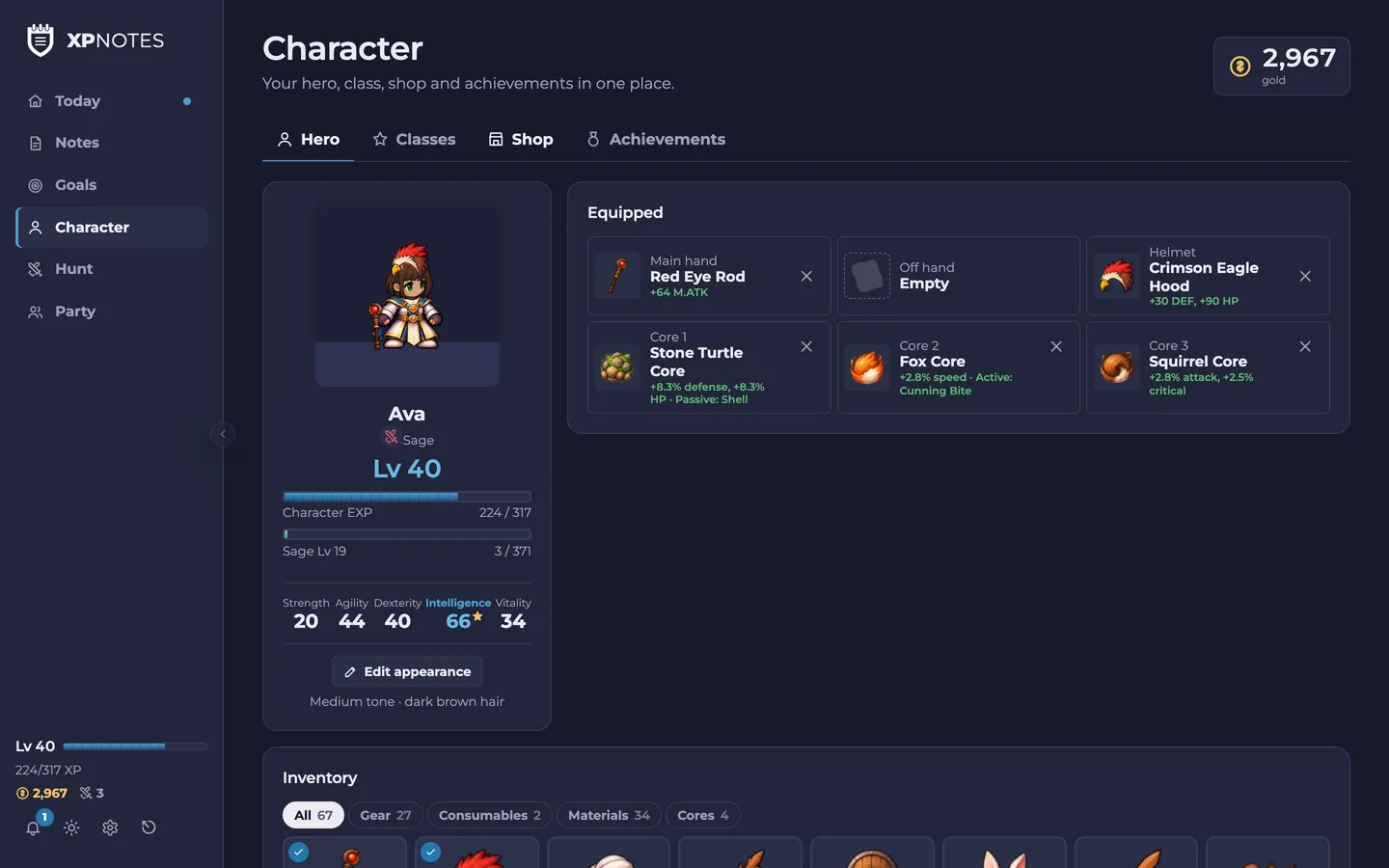
Warrior, mage or healer: each class has strengths and weaknesses. In life, your "class" is the role you want to play right now (student, professional, caregiver, creator). You can switch classes, and there is no shame in it. XPNotes, for example, has 23 playable classes, and the first base class is free; the "level a class, then specialize" logic resembles the path of any career.
The campaign: your life goal as the main story
Every good RPG has a main quest and several side quests.
- Main quest: the life goal that gives meaning to the rest (switching careers, passing an exam, exercising again, getting your finances in order).
- Side quests: everything that supports the main one or simply makes life lighter.
- Grinding: the repetitive tasks that are not thrilling but produce progress. Nobody levels up on cutscenes alone.
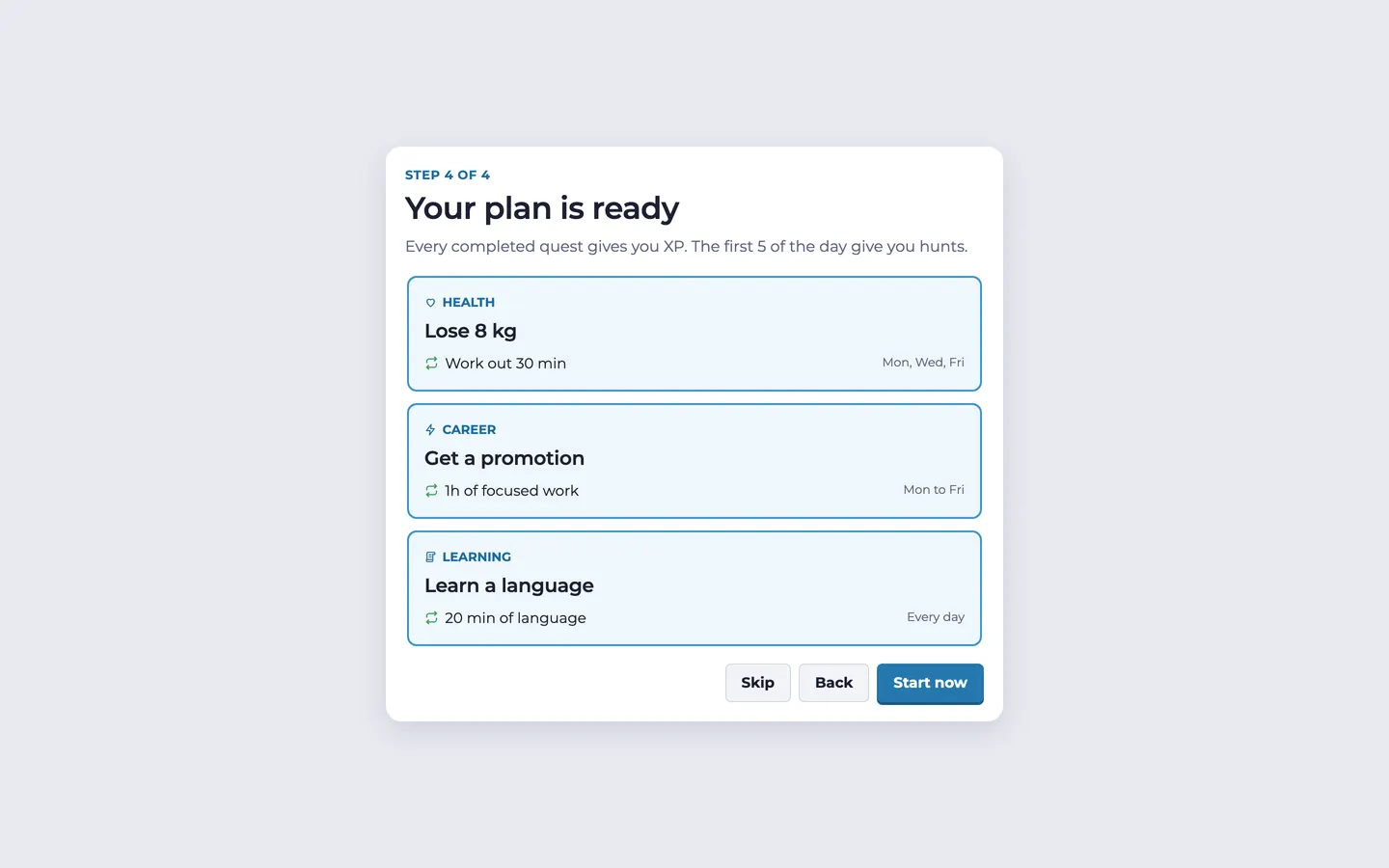
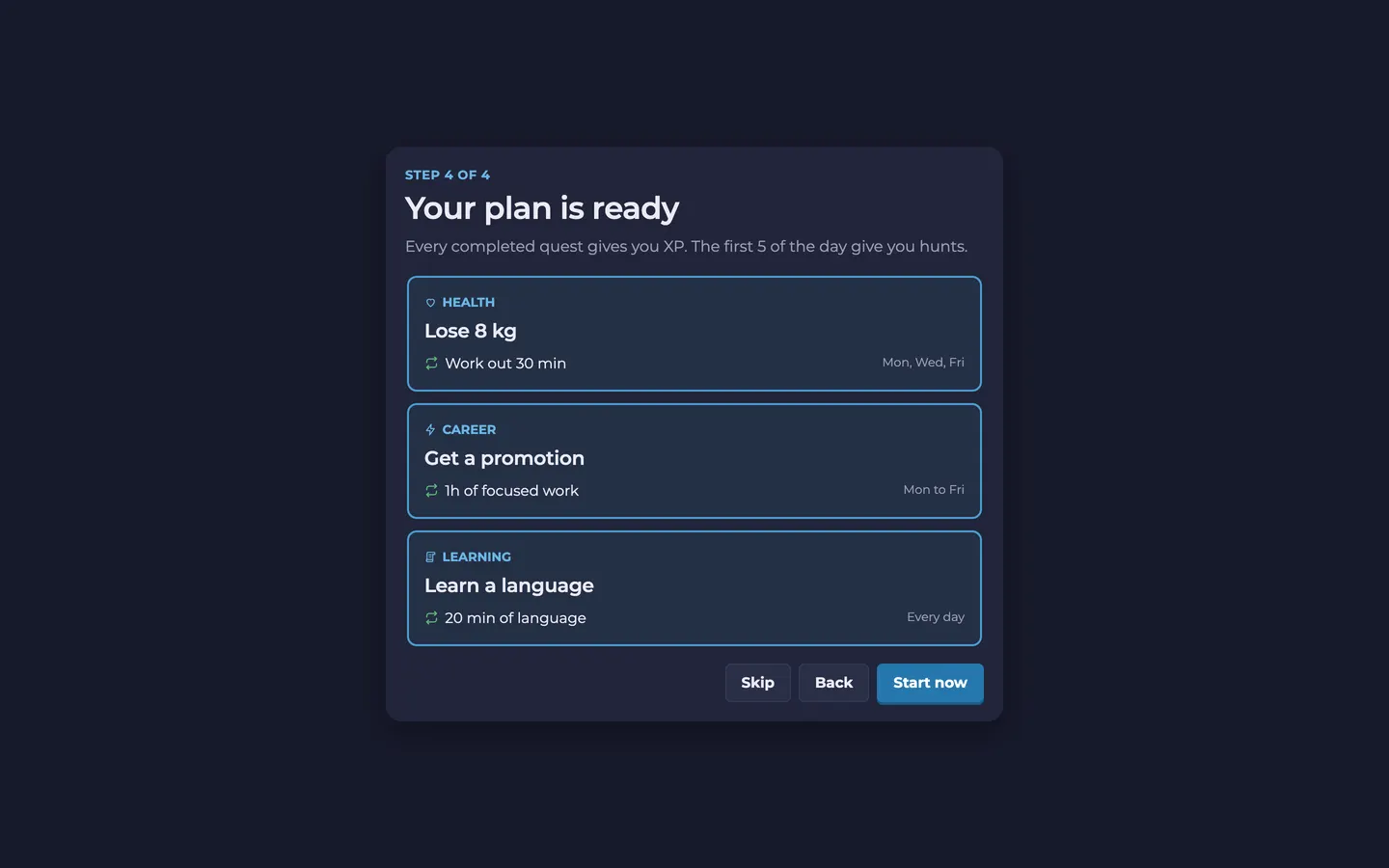
Write your campaign in one sentence: "In six months, I want to be ______." Then pick the three recurring quests that pull hardest toward it. For the step by step, read how to turn a life goal into daily quests.
Quests, XP and the power of visible progress
An RPG quest has four qualities that carry over to life:
- Small: it fits in one session.
- Clear: you know when you are done.
- Rewarded: something happens when you finish.
- Chained: one quest leads to the next.
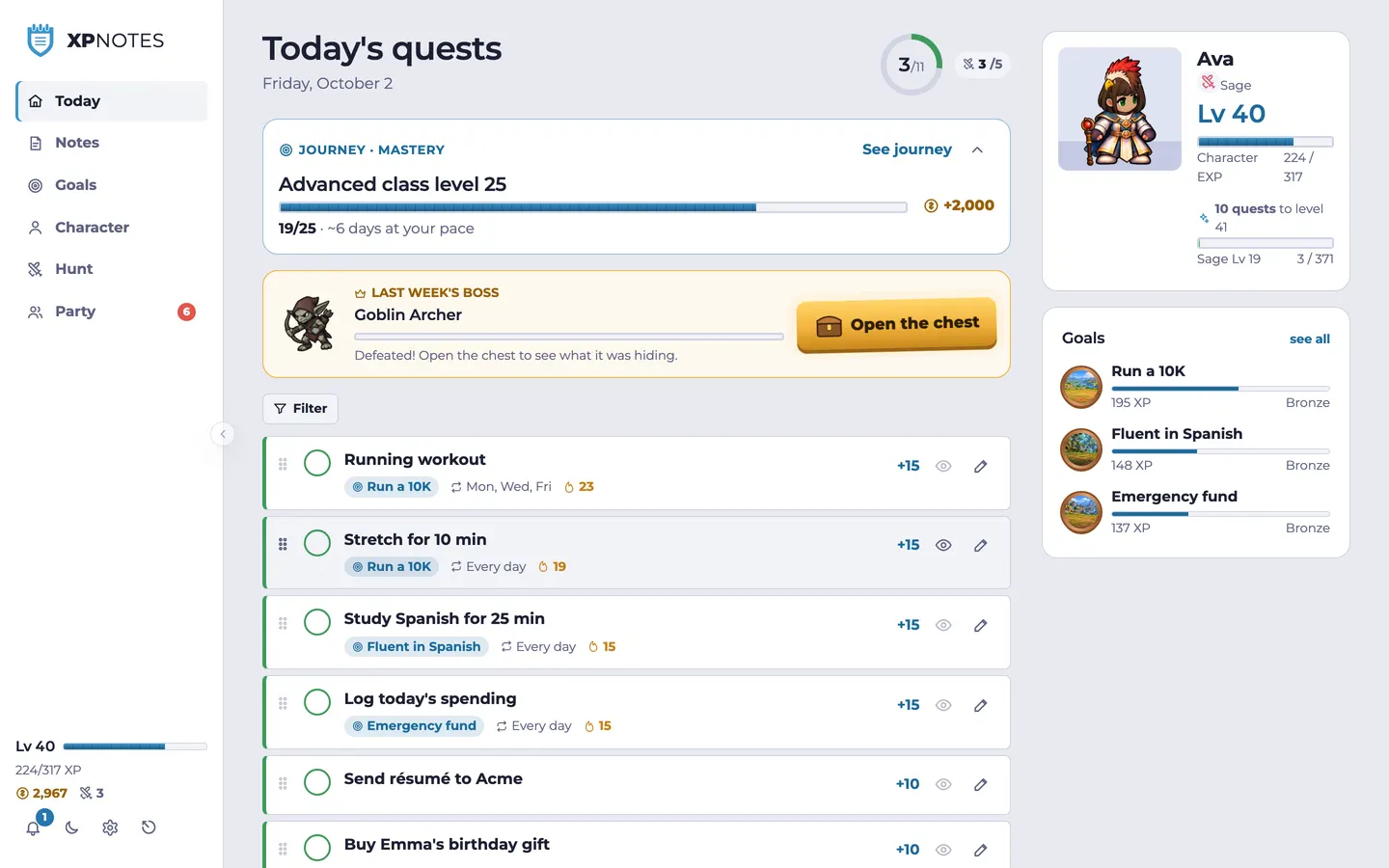
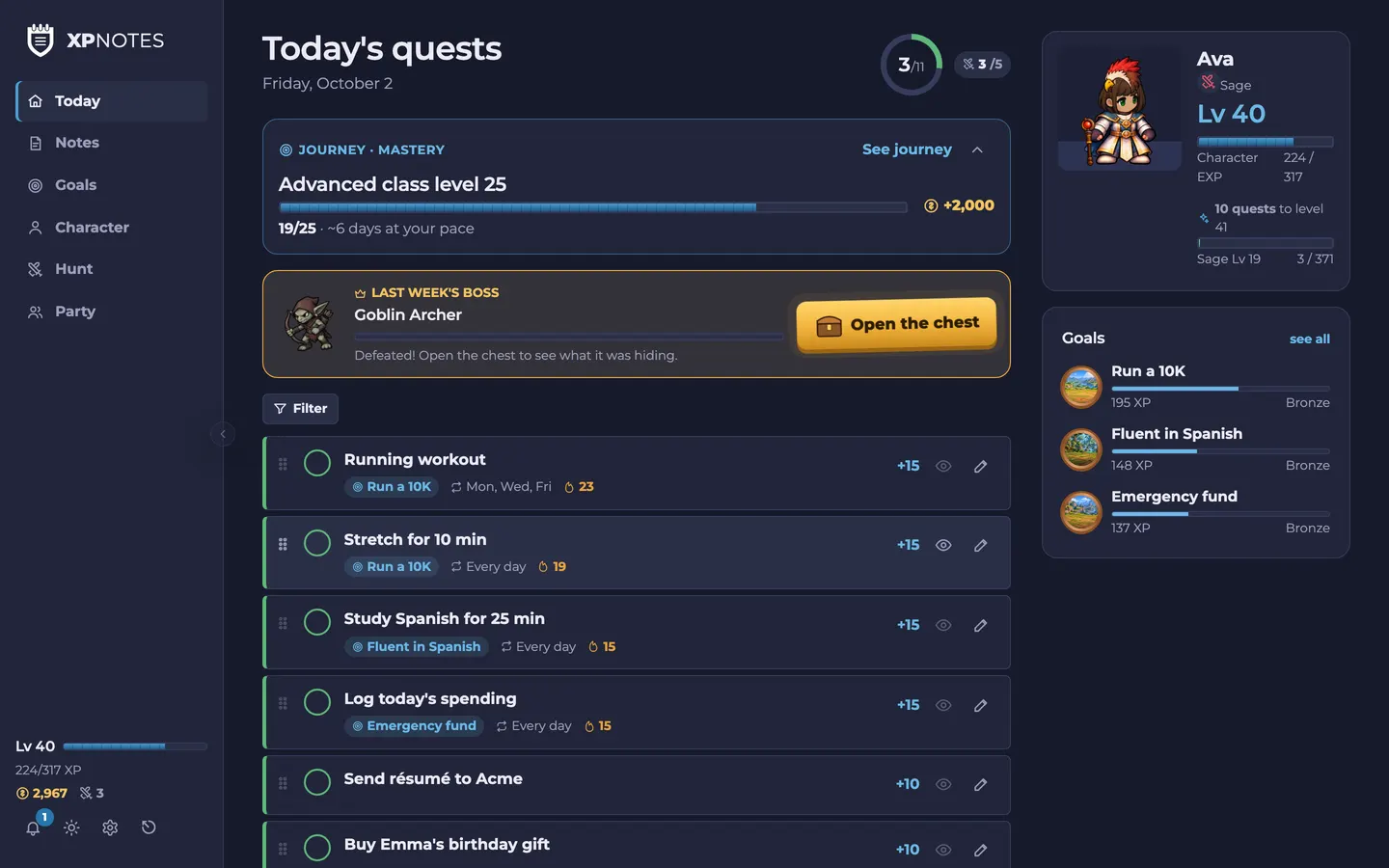
In XPNotes, every completed quest gives 10 XP, and level 2 takes two quests. The start is fast so you feel the loop of "act, see the result, repeat". The game only moves when your life moves: nothing in the app rewards spending more time in it.
Bosses: facing what feels too big
You do not beat an MMORPG boss in one go. You study the pattern, prepare gear, go phase by phase and accept losing a few attempts. Apply the same to life's obstacles:
- Study the boss. What are the parts of the problem? A debt, an exam, a project.
- Split it into phases. Each phase becomes a quest.
- Prepare. Rest, help and tools count as gear.
- Accept defeats. A bad attempt teaches the pattern; it does not define the character.
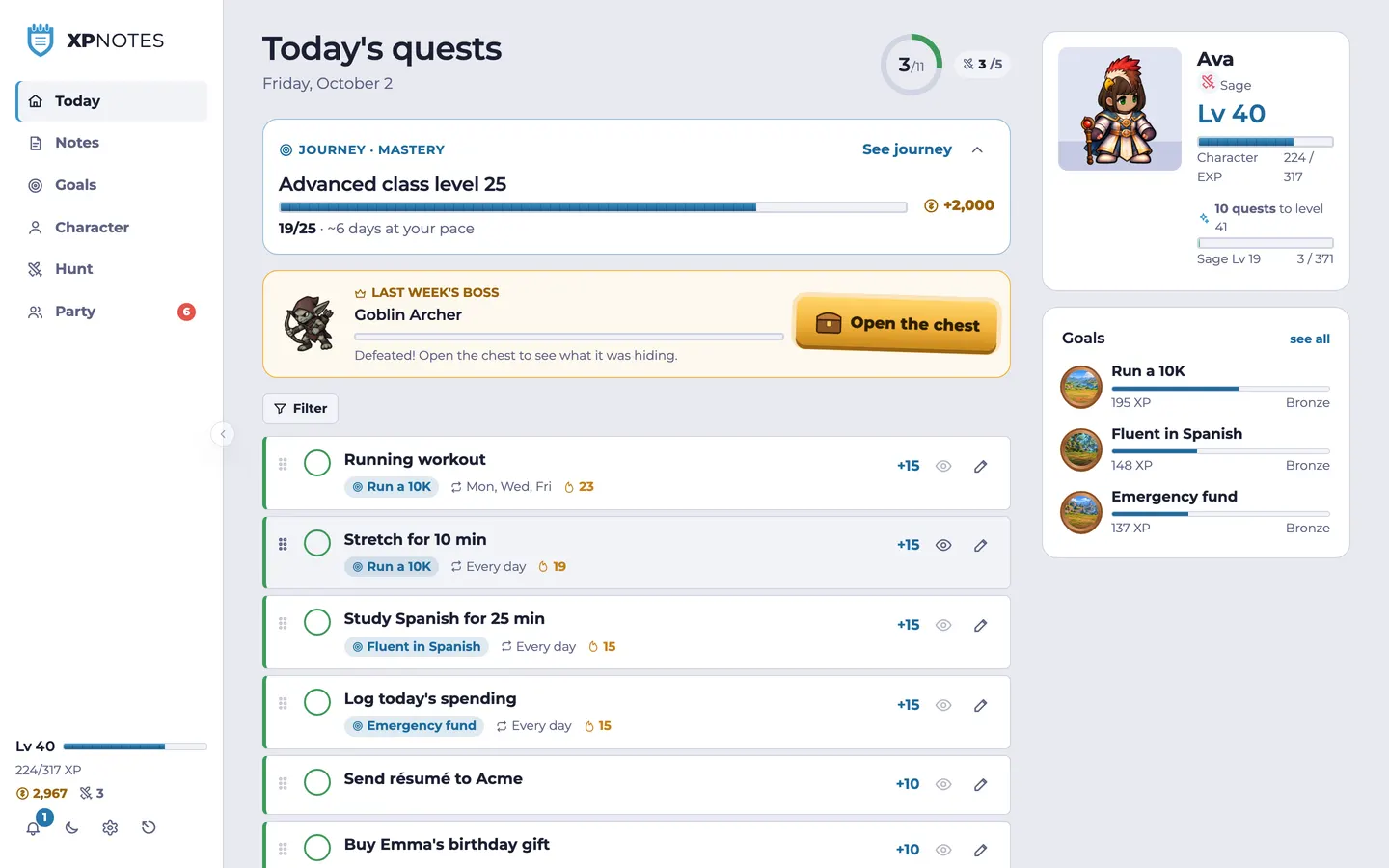
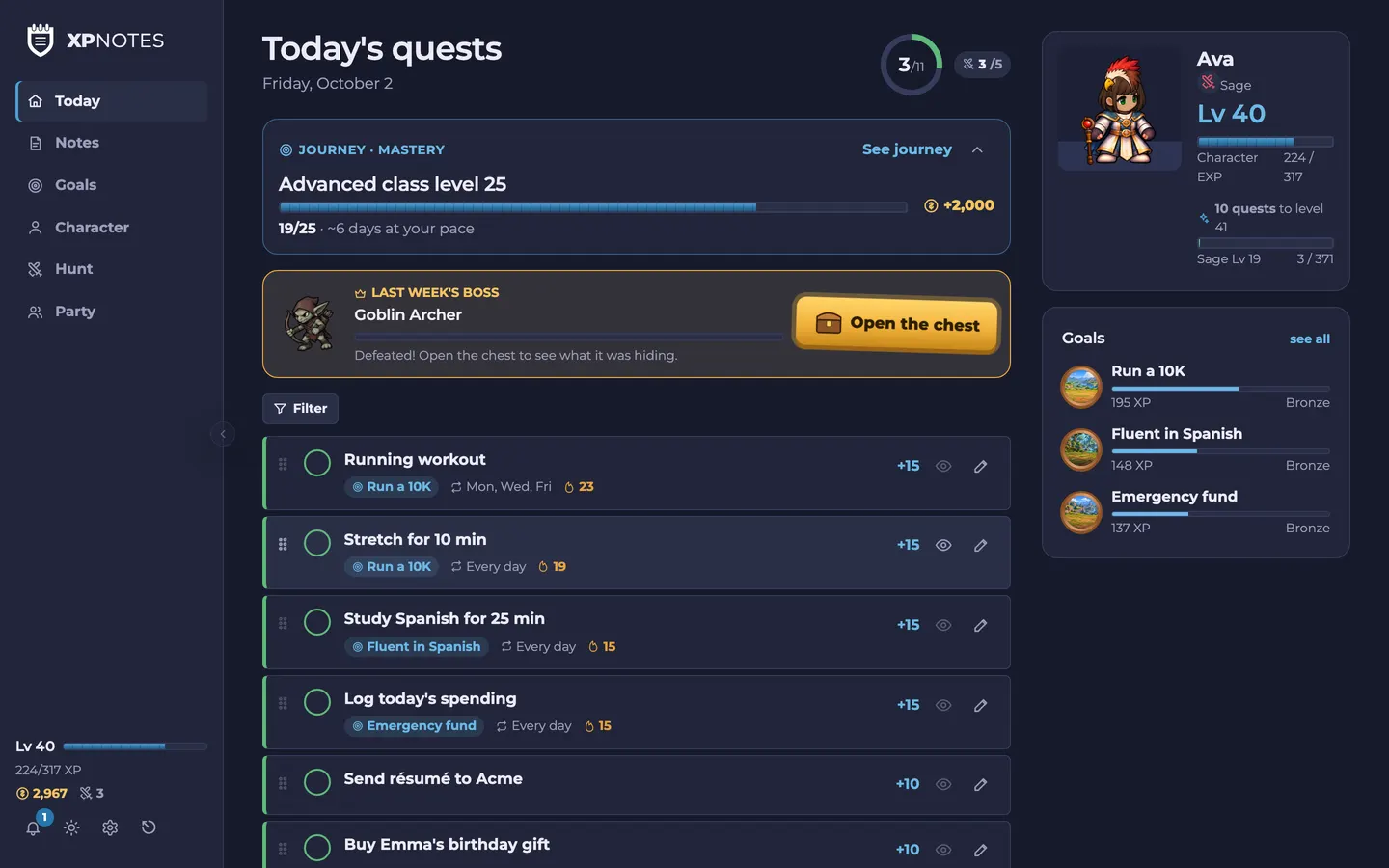
In XPNotes, a boss shows up every week with health equal to 80% of your scheduled recurring quests, and it loses health as you complete them. The idea is to turn the week into a short, visible fight.
Party: nobody clears the campaign alone
Many memorable moments in an MMORPG come from playing with people. Same in life: a study partner, a workout friend, a mentor. A small party helps you stay consistent without toxic competition. If you play online, also read how to play an MMORPG without putting your life on hold, with ideas to balance both campaigns.
When the game fails: dying, resting and trying again
- Dying is part of it. In a game, a wipe does not erase the campaign. In life, a bad day does not erase a week.
- Resting is healing. Whoever never rests reaches the boss with no HP.
- Change your build. If a strategy is not working, change the routine before blaming yourself.
- Watch for escapism. Thinking like a player helps you act, but it does not replace talking to a professional when something weighs too much. Seek qualified help if you need it.
Your first day of the campaign
- Write your campaign in one sentence.
- Pick three small quests for tomorrow.
- Set a time to open the list.
- Finish the first one and celebrate.
- At the end of the week, review: what leveled up? What got stuck?
If you want a ready-made map, start free on XPNotes and set up your campaign in a few minutes. To see what each feature does, visit the features page.
Frequently asked questions
What does it mean to treat life as an RPG?
It means organizing life with RPG language: character, campaign, quests, bosses and party. The idea is to give your goals clarity and visible progress without escaping reality.
Does thinking like a player work for everyone?
Not necessarily. Research suggests that clear goals and mastery experiences motivate, but the effect varies from person to person. Try it for a few weeks and adjust what does not work.
Do I need to like RPGs to use this mindset?
It helps because the language is familiar, but it is not required. What matters is a clear goal, small quests and a way to see progress.
How do I pick my class in real life?
Ask which role you want to play now and which areas you need to strengthen. Your class can change over time; choose the one that fits the current stage of your campaign.
What if I get frustrated by a lack of progress?
Shrink the quests, review the campaign and remember that bad days are part of the game. If the frustration weighs too much or lasts too long, talk to a professional.
Sources
- From game design elements to gamefulness: defining gamification
- Self-efficacy: toward a unifying theory of behavioral change
- Building a practically useful theory of goal setting and task motivation
- Self-determination theory and the facilitation of intrinsic motivation, social development, and well-being
Turn your goals into quests
Build your campaign in XPNotes and earn XP for what you actually do. The Free plan is complete.
Start free