

How to Achieve Life Goals: From Dream to Today’s Quest

Most of us have written a list of goals in January and forgotten it by February. That rarely means a lack of discipline; it usually means a lack of translation. "Get fit" or "fix my finances" is a dream, but your body and your calendar only understand what to do today. This guide walks the whole path, from the dream to today's quest, the way an RPG player would plan it.
Why do life goals so often stay on paper?
Three stumbles show up again and again:
- A vague goal. "Improve my health" never tells you when you've started or finished. Locke and Latham's 35-year review of goal-setting research found that specific, challenging goals work better than "do your best."
- Too many goals. Five fronts at once become five abandoned fronts. In an RPG, nobody keeps track of twelve main quests at the same time.
- No "when and where." Wanting isn't enough; you have to decide at what moment of the day the action happens.
Each of these has a simple fix, and the steps below follow that order.
Step 1: pick only a few areas of your life
Start by looking at the areas: health, family, finances, career, studies, mind, faith, others. Don't try to tend all of them at once. In XPNotes, the first screen after sign-up asks "What do you want to improve in your life?" and lets you choose at most 3 areas. That's on purpose: three fronts fit into a real week.
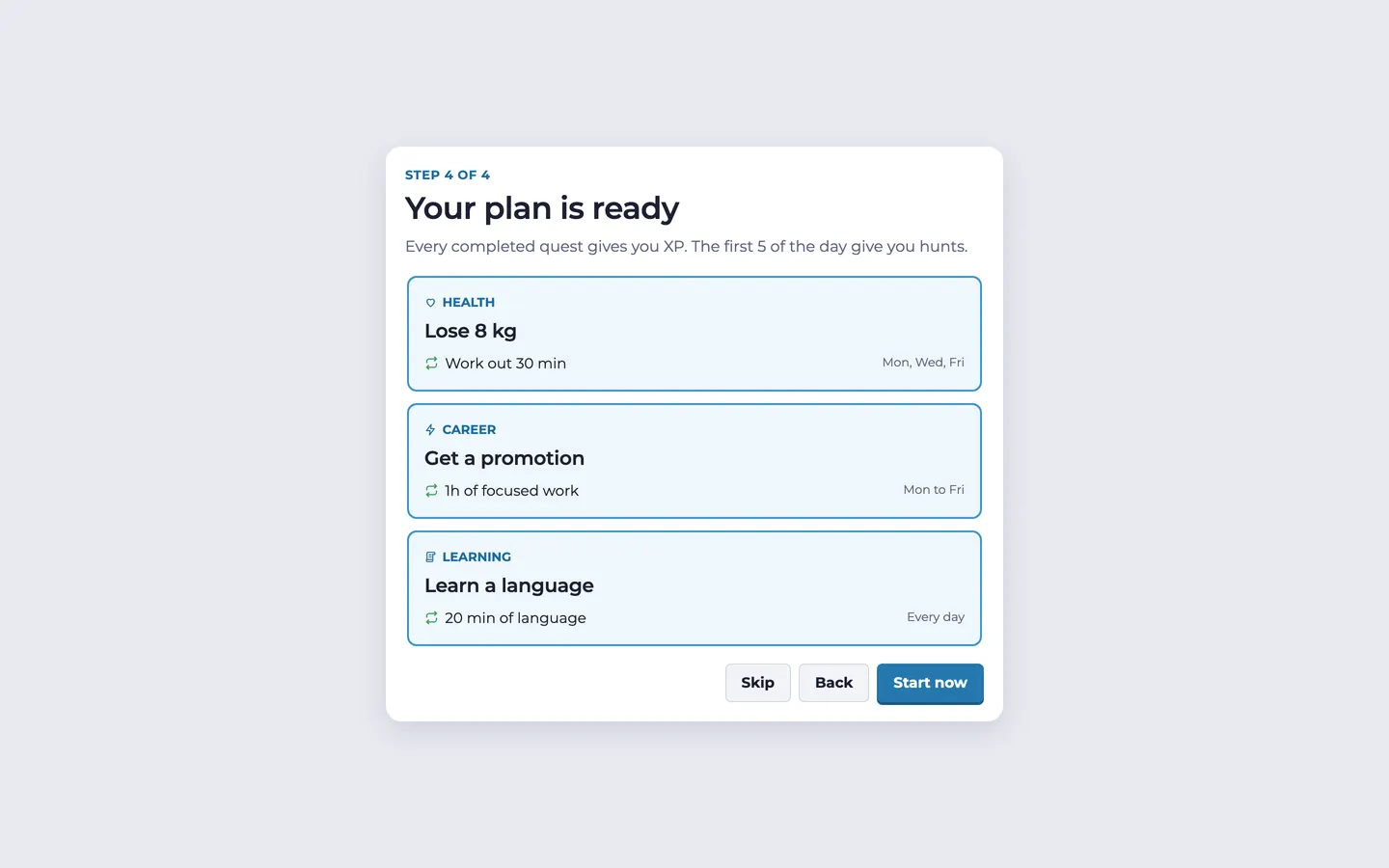

Gamer tip: think campaign, not wish list. A campaign has a clear start, an order and an ending. If an area feels too heavy right now, leave it for the next season of your life; it won't disappear.
Step 2: write a specific goal that stretches you a bit
For each area, write one goal that looks like a finish line:
- Vague: "take care of my money."
- Specific: "have three months of expenses saved by December next year."
Specific doesn't mean impossible. Locke and Latham's review shows that specific, demanding but achievable goals beat easy or generic ones. Ask yourself: how would I know I'm done? If the answer is "I don't know," rewrite it.
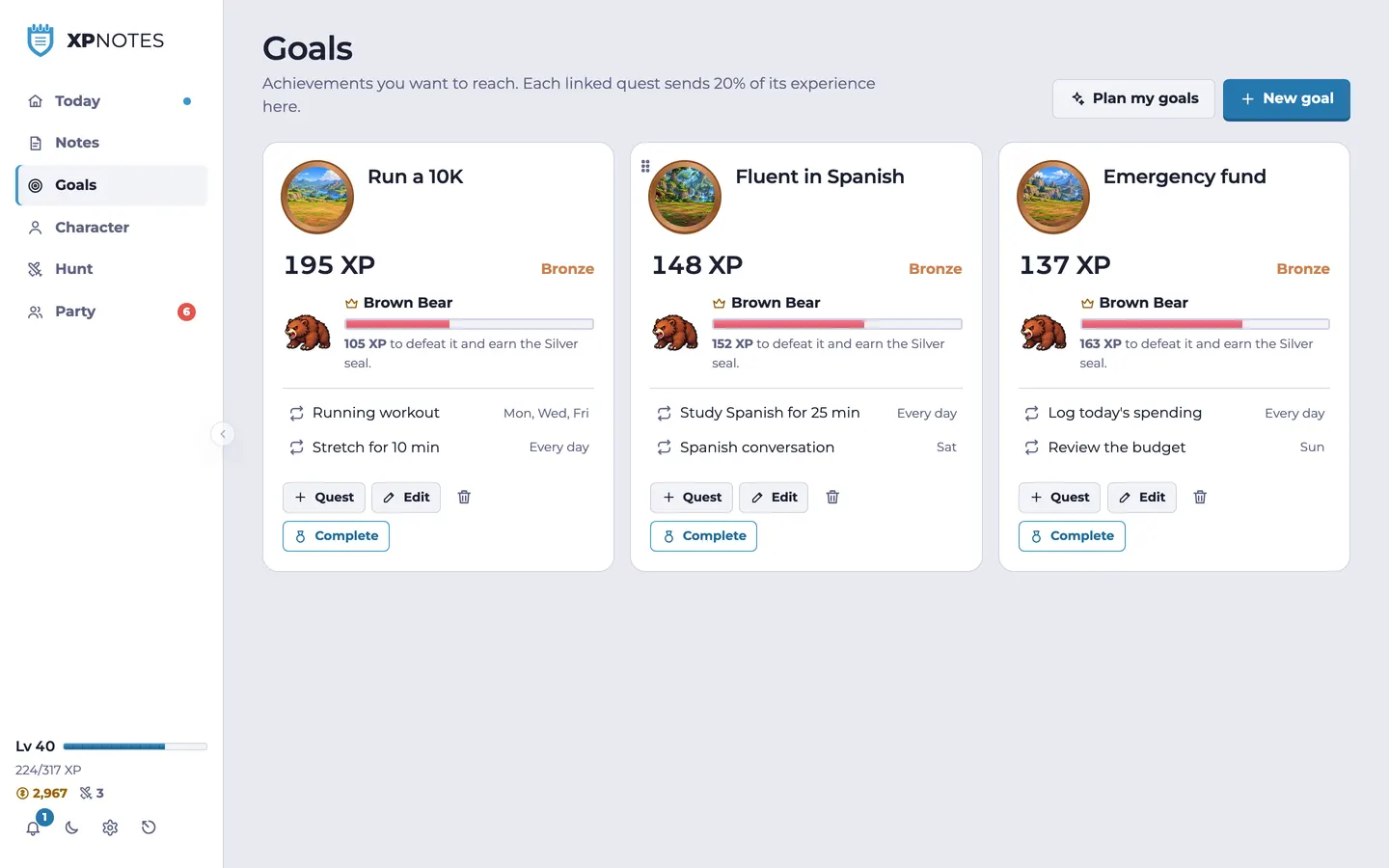
In the app, each goal gets a photo and a badge that rises with accumulated XP: Bronze at 50 XP, Silver at 300, Gold at 900, Platinum at 2,200 and Diamond at 5,000. That makes visible a goal that takes months in real life.

Step 3: break it into small, repeatable quests
You can't execute a big goal; you execute quests. For each goal, choose one or two habits small enough to do even on a bad day:
| Goal | Recurring quest |
|---|---|
| Save three months of expenses | Move savings on payday |
| Finish a course | 25 minutes of study, Monday to Friday |
| Start exercising again | 20 minutes of exercise at home after waking up |
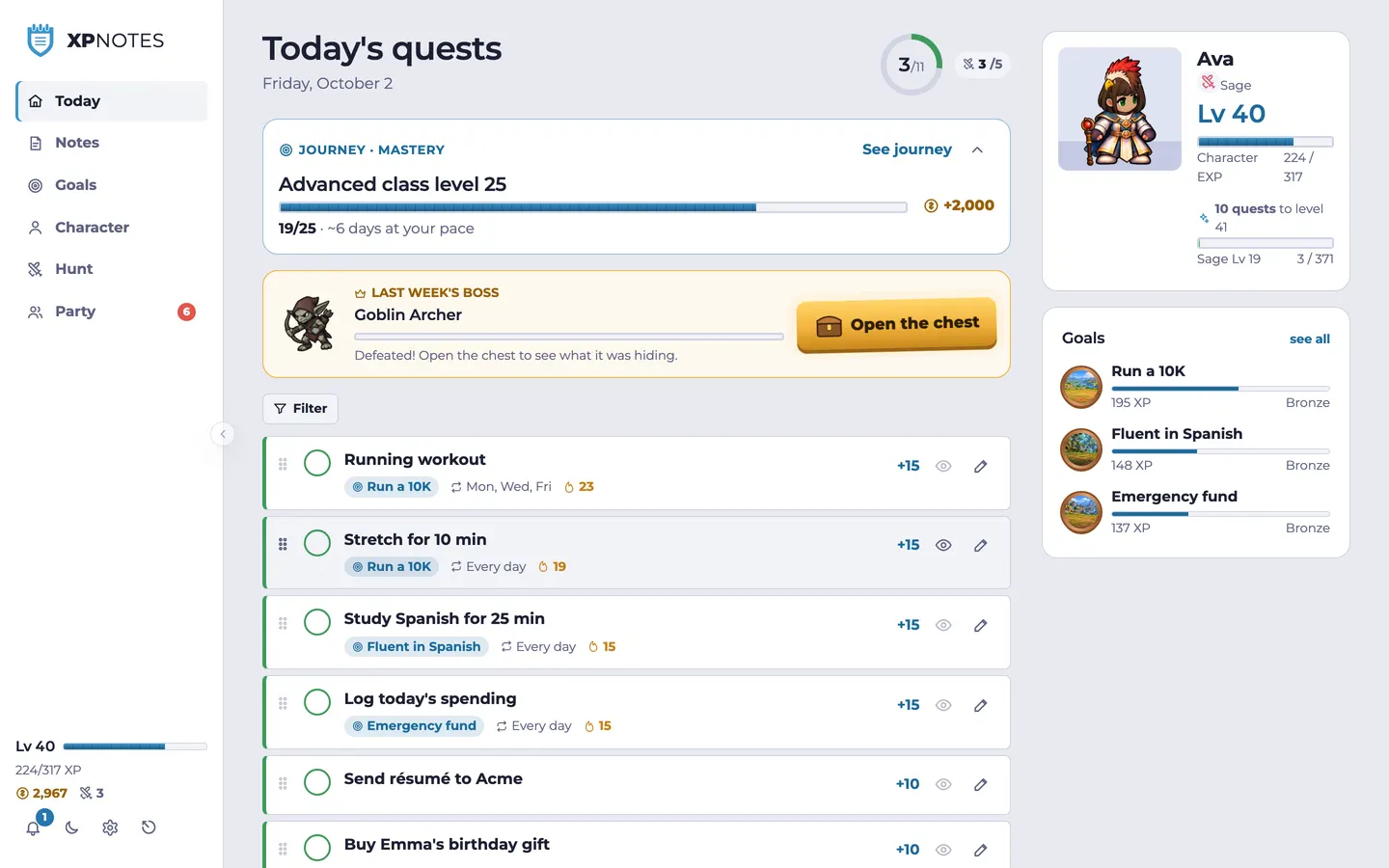
Every quest completed in XPNotes is worth 10 XP, and the goal linked to it receives a share. An ordinary day feeds the big goal. If you prefer to think freely first, use Notes: write down everything on your mind and convert the lines that are tasks into quests.

Step 4: say when and where
There is a simple technique, studied for decades, called an implementation intention: instead of "I'll exercise," you decide "if it's 7 a.m. and I've finished my coffee, then I do my 20 minutes in the living room." Gollwitzer and Sheeran's meta-analysis of 94 independent tests found that this kind of if-then plan consistently helps people follow through on what they intended.
Apply it like this: give every recurring quest a trigger that already exists in your routine (waking up, lunch, getting home, closing your laptop). You stop deciding every time and simply execute.
Step 5: celebrate and track what you did, not time spent in the app
The part many people skip: progress has to be seen. In XPNotes, finishing a quest triggers a celebration right away, and the week becomes a fight against a boss: its health equals 80% of the recurring quests scheduled for the week, and it drops with every quest you complete.
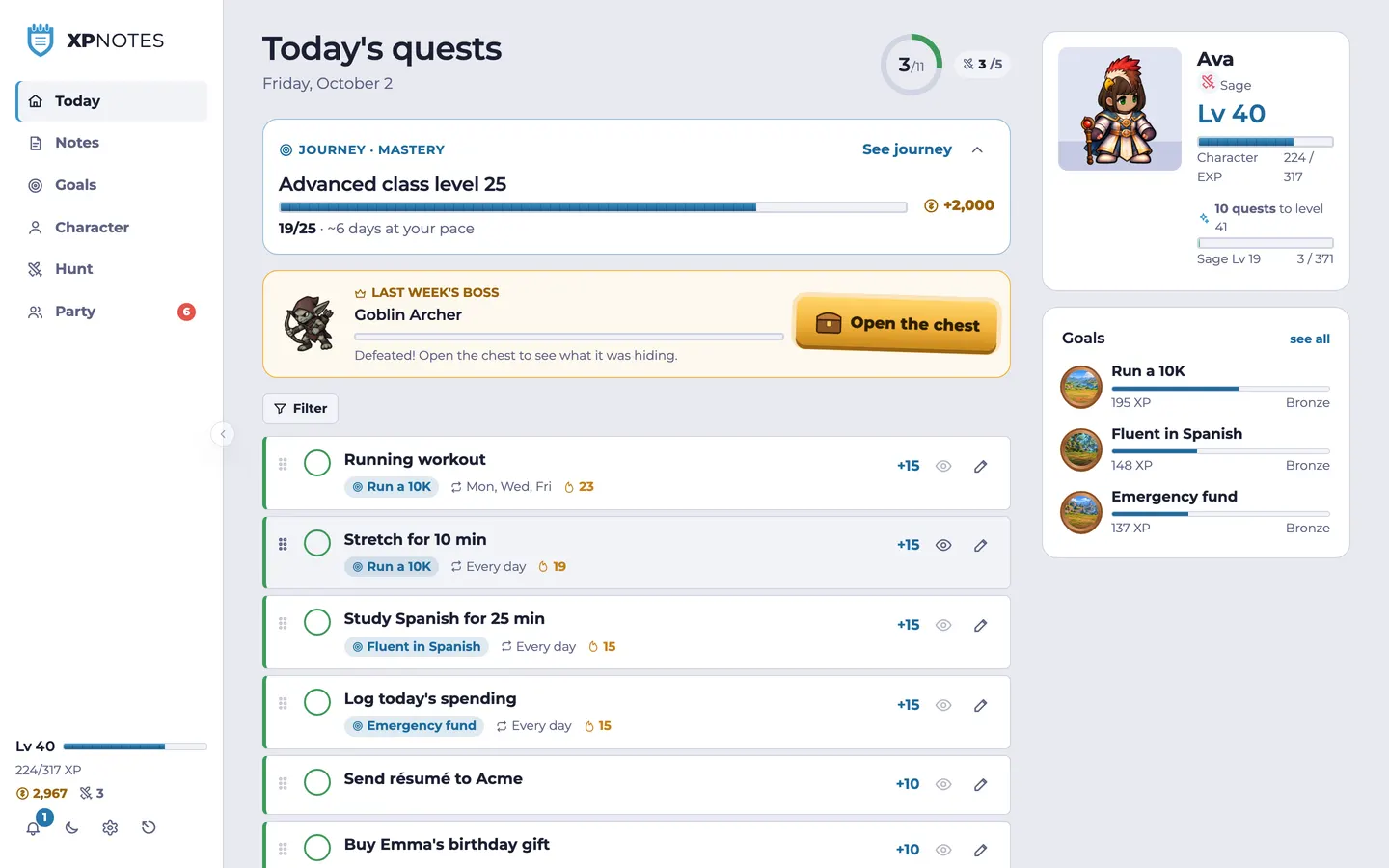

One honest point about the project: the game only moves when your life moves. Opening the app earns nothing; XP and hunts come from completed quests.
How long does it take to form a habit?
You've probably heard it takes 21 days. The study by Lally and colleagues (2010) followed 96 volunteers for 84 days and found that the time until the behavior felt automatic varied widely, from 18 to 254 days between people. Missing a single day did not materially affect the process.
In practice: don't plan around "it'll feel easy in three weeks." Plan for months and forgive the stumble. Missed a day? Pick up the next one, without restarting the count in your head.
How to review without piling up goals
Goals change. Some phases of life have many, others few, and that's fine. Two rules help:
- A short weekly review (5 minutes): what moved, what got stuck, what the next small quest is.
- A cap on active goals: if a new one comes in and doesn't fit, pause another on purpose instead of letting it rot on the list.
When you complete a goal, celebrate properly: in the app the photo becomes a medal and the XP stays with you.
A full example, from dream to quest
- Dream: get my energy back.
- Area: health.
- Specific goal: do 20 minutes of exercise at home, 5 times a week, for 3 months.
- Recurring quest: "3 exercises, 20 minutes," Monday to Friday.
- Trigger: right after waking up and before opening my phone.
- Review: Sunday, 5 minutes, adjusting whatever didn't work.
Notice that nothing here demands heroic willpower: the plan shrinks the decision to one step.
Where to start today
Pick one area, write one goal with a finish line and create one quest with a trigger. If you want help organizing it, our guide to turning a life goal into daily quests gives the step-by-step, and the gamification guide explains the general logic. If you play a lot, also read how to play an MMORPG without putting life on hold. To see how the pieces fit together, check how XPNotes works and the goals page.
Want to try the plan in the app itself? Start free.
Frequently asked questions
How many life goals should I have at once?
Few. A good rule is one to three areas, with one goal in each. In XPNotes the campaign setup caps it at 3 areas. If a new goal comes in and doesn’t fit, pause another on purpose.
How do I know if my goal is well written?
Ask: how would I know I’m done? If the answer includes a number, a date or a visible result, it’s specific. If not, rewrite it until it has a clear finish line.
How long does it take to build a habit?
It varies a lot. In a study that followed 96 volunteers for 84 days, the time until the behavior became automatic ranged from 18 to 254 days between people. Plan for months, not 21 days.
What should I do when I miss a day?
Pick it up the next day. In the same study, missing a single occasion did not materially affect habit formation. The problem is dropping the plan entirely, not missing a day.
Does XPNotes replace a real plan?
No. It helps you execute: it turns the goal into daily quests, shows progress and celebrates every action done. The plan and the effort are still yours.
Sources
- Building a practically useful theory of goal setting and task motivation: A 35-year odyssey
- Implementation intentions and goal achievement: A meta-analysis of effects and processes
- How are habits formed: Modelling habit formation in the real world
Turn your goals into quests
Build your campaign in XPNotes and earn XP for what you actually do. The Free plan is complete.
Start free