

How to Gamify Your Life: The Complete Guide

If you can raid for hours in an MMORPG and then struggle to keep up a ten-minute task in real life, the problem is rarely character. Games are clarity machines: they tell you what to do now, show your progress and celebrate each step. This guide shows how to bring that logic into your life, with both feet on the ground.
What does it mean to gamify your life?
The most common definition in research is that gamification is the use of game design elements in non-game contexts (Deterding et al., 2011). For personal life, that means borrowing four pieces from any RPG:
- Quests: small, concrete tasks with a start and an end.
- Experience points (XP): a number that goes up when you act.
- Levels and milestones: visible proof that yesterday's effort counts today.
- Instant feedback: the reward arrives the moment you finish, not at the end of the month.
Gamifying is not turning life into a toy or pretending everything is fun. It is building a system where the next step is obvious and progress is visible.
Does gamification work? What the studies say
The honest answer: it helps in many cases, but it is not magic.
A classic review of empirical studies found that gamification usually has positive effects, but that they depend heavily on context and on the users. The authors also flag a novelty effect: early interest can fade over time (Hamari, Koivisto and Sarsa, 2014).
A later meta-analysis on learning found small to moderate effects: g = 0.49 for cognitive outcomes, 0.36 for motivation and 0.25 for behavior. The motivation and behavior results were less stable than the cognitive one (Sailer and Homner, 2020). Note that this study is about learning, not personal productivity, so treat it as a clue, not a guarantee.
Two practical takeaways:
- Expect a small, useful effect, not an instant transformation.
- Be wary of novelty: the system must still make sense after the first week.
Why does a gamer brain like this?
Self-determination theory proposes three basic psychological needs: competence, autonomy and relatedness. When they are met, motivation tends to be healthier and longer lasting (Ryan and Deci, 2000). A good gamified system serves all three:
- Competence: you see your level rise and your quests pile up.
- Autonomy: you choose what goes into your game; nobody hands you the list.
- Relatedness: a group of friends who see your consistency.
In gamer terms: it is the same reason a well-designed class is fun to level.
The 6 elements of a system that works
1. A goal that gives the quests meaning
Points without direction are just points. Goal research suggests that specific, challenging goals tend to produce better performance than vague ones like "do your best" (Locke and Latham, 2002). Write your life goal in one sentence and connect every quest to it. For more on this, read how to turn a life goal into daily quests.
2. Small, concrete quests
"Get in shape" is not a quest. "Exercise for 20 minutes after waking up" is. A good quest fits in one day, has a clear definition of done and does not depend on mood.
3. A plan for when and where
"If X happens, I do Y" plans (implementation intentions) showed a medium-to-large effect in a meta-analysis of dozens of studies (d = 0.65, Gollwitzer and Sheeran, 200638002-1)). In game terms: "after coffee, I open Today and do the first quest."
4. Points with fair rules
XP has to come from real actions. If points reward screen time, the system becomes one more game that farms your attention. If they reward what you did, it pulls you away from the screen.
5. Visible progression
Level, XP bar, goal badges, weekly boss. Seeing progress turns an ordinary week into a campaign.
6. A little company
A small group of real friends makes consistency lighter. No toxic competition: the point is to see that other people are playing their lives too.
Step by step: build your own game
- Pick 1 to 3 life goals. More than that scatters your attention. Think health, study, work, money or family.
- Break each goal into recurring and one-off quests. Recurring: "walk 20 minutes". One-off: "book the appointment".
- Keep points simple. One quest is worth the same as another. Trying to rate "difficulty" creates friction and arguments with yourself.
- Set your "game time". A fixed moment to open the day's list.
- Celebrate right away. Check it off, watch the number rise, breathe. The emotional part matters.
- Review every week. What got too easy? What never gets done? Adjust the quest, not your self-esteem.
How long until it becomes a habit? One study of volunteers repeating a daily behavior found a median of 66 days to reach automaticity, ranging from 18 to 254 days, and isolated missed days did not seem to hurt much (Lally et al., 2010). The study relied on self-report and a small sample, so read the number as an order of magnitude: patience is part of the game.
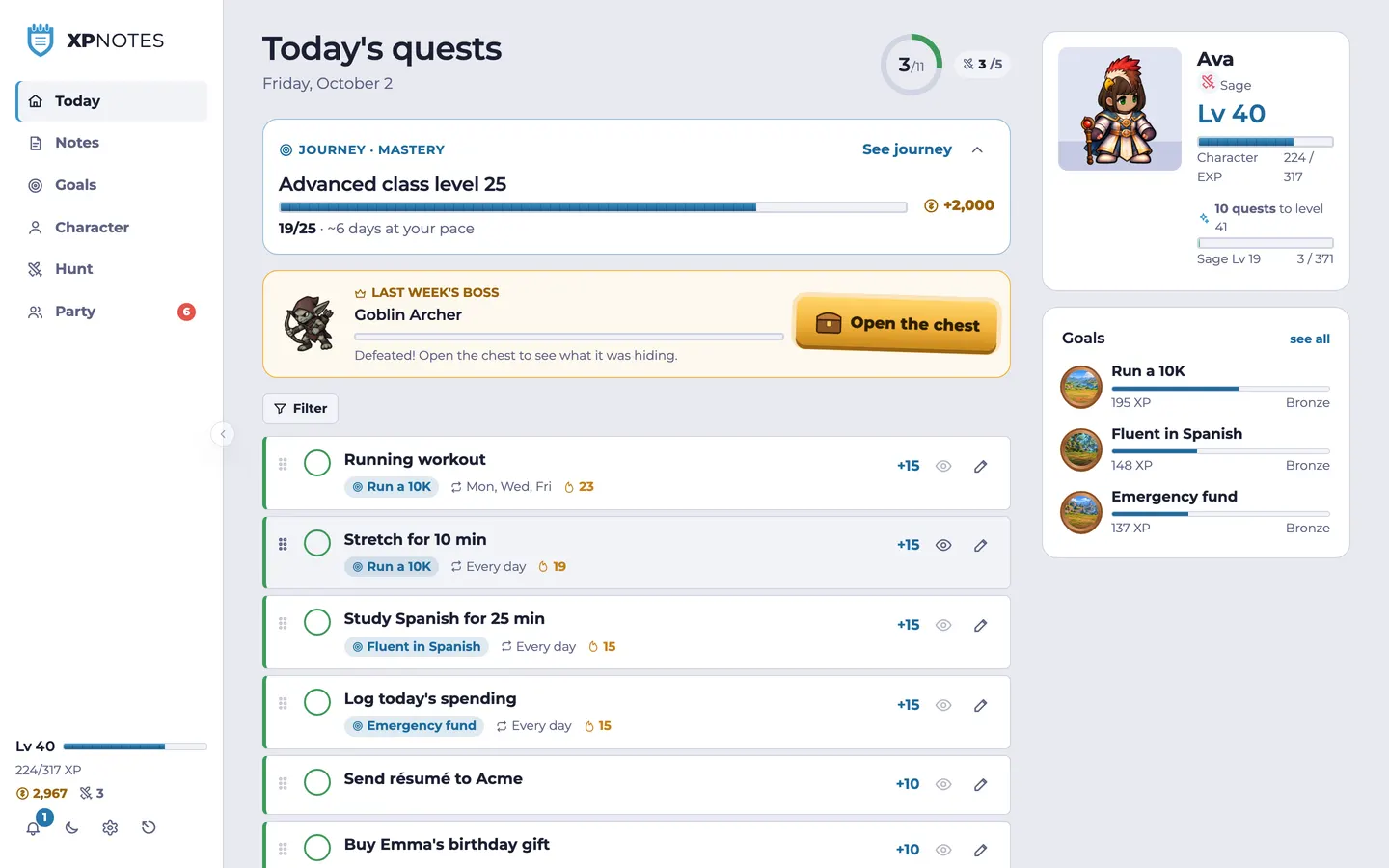
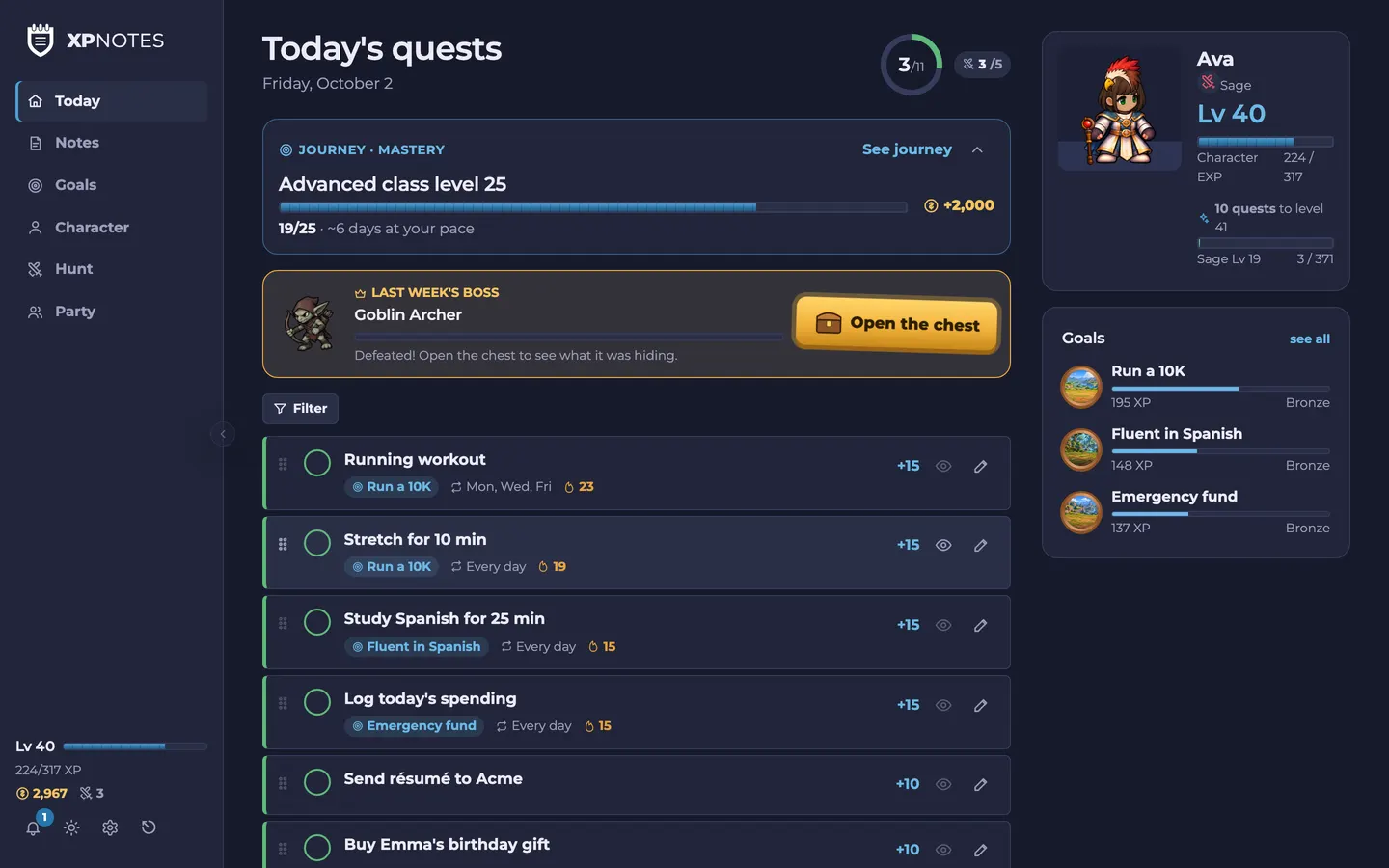
A real example: how XPNotes does it
XPNotes is built around these ideas. Some of the game rules as they exist today:
- Every completed quest gives 10 XP. There is no "difficulty": a quest is a quest.
- Level 2 takes 20 XP, which is two quests. The start is fast on purpose.
- Quests linked to a life goal earn +20% XP.
- Each completion has a 10% chance of being a critical hit, worth double.
- Each of your first five quests of the day earns one hunt: a fight against monsters that gives gold, materials and items (combat gives no XP).
- Every week a boss appears with health equal to 80% of your scheduled recurring quests; it loses health as you complete them.
- There are diminishing returns: after 15 quests in a day the XP drops, and there is a daily cap. Checking off 50 things is not the goal.
- No ads, no loot boxes, and we never sell XP, gold, power or progression time.
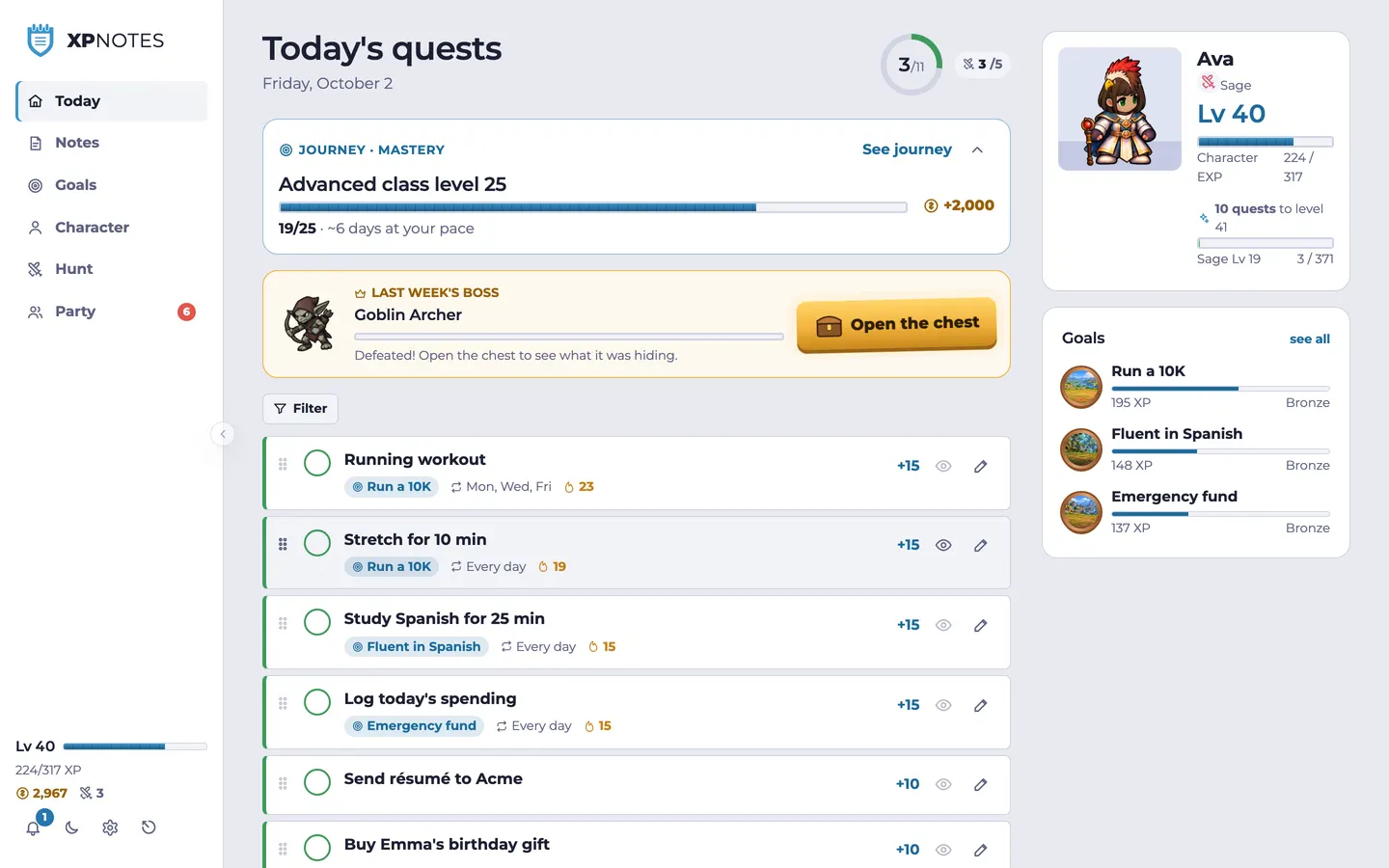
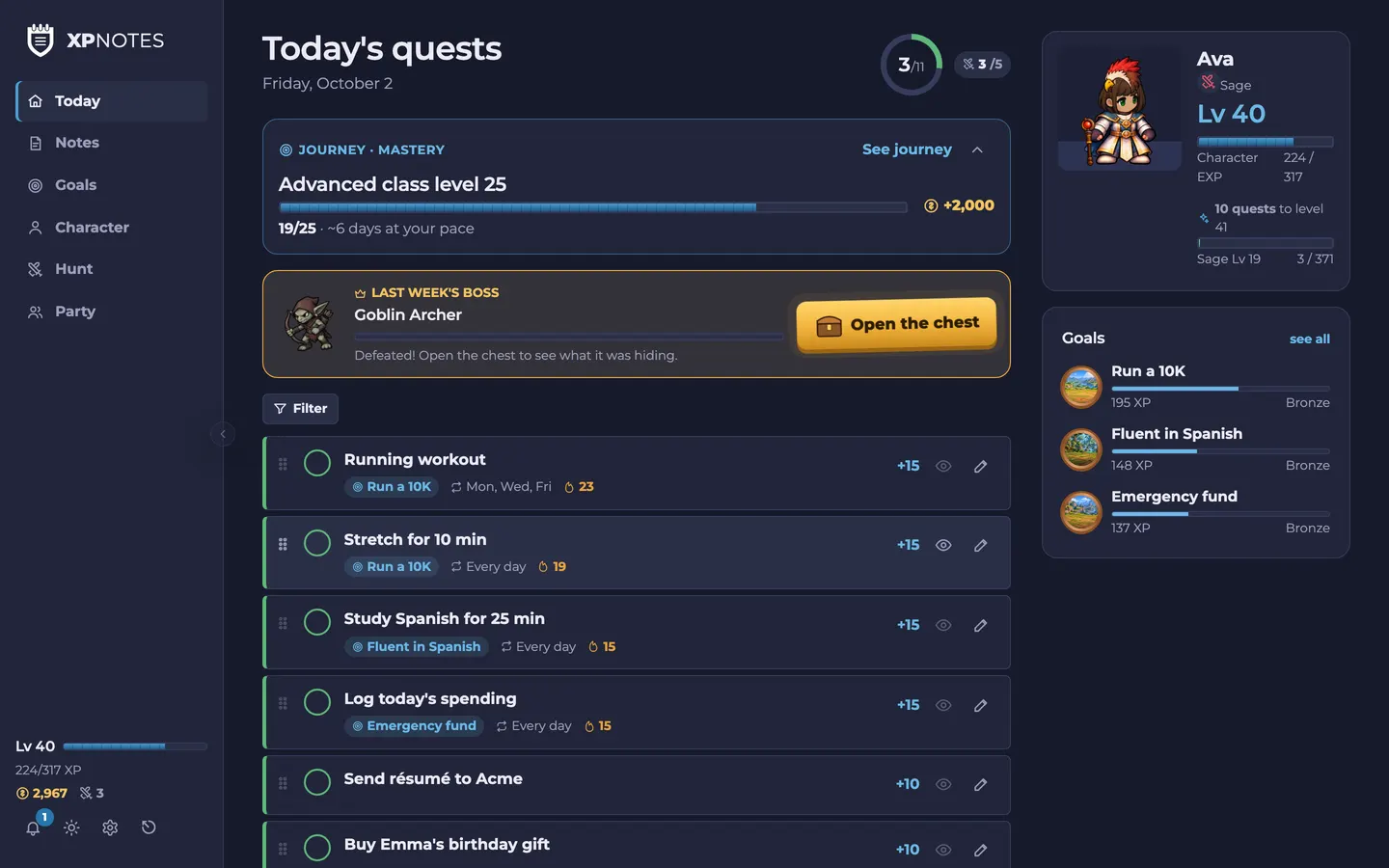
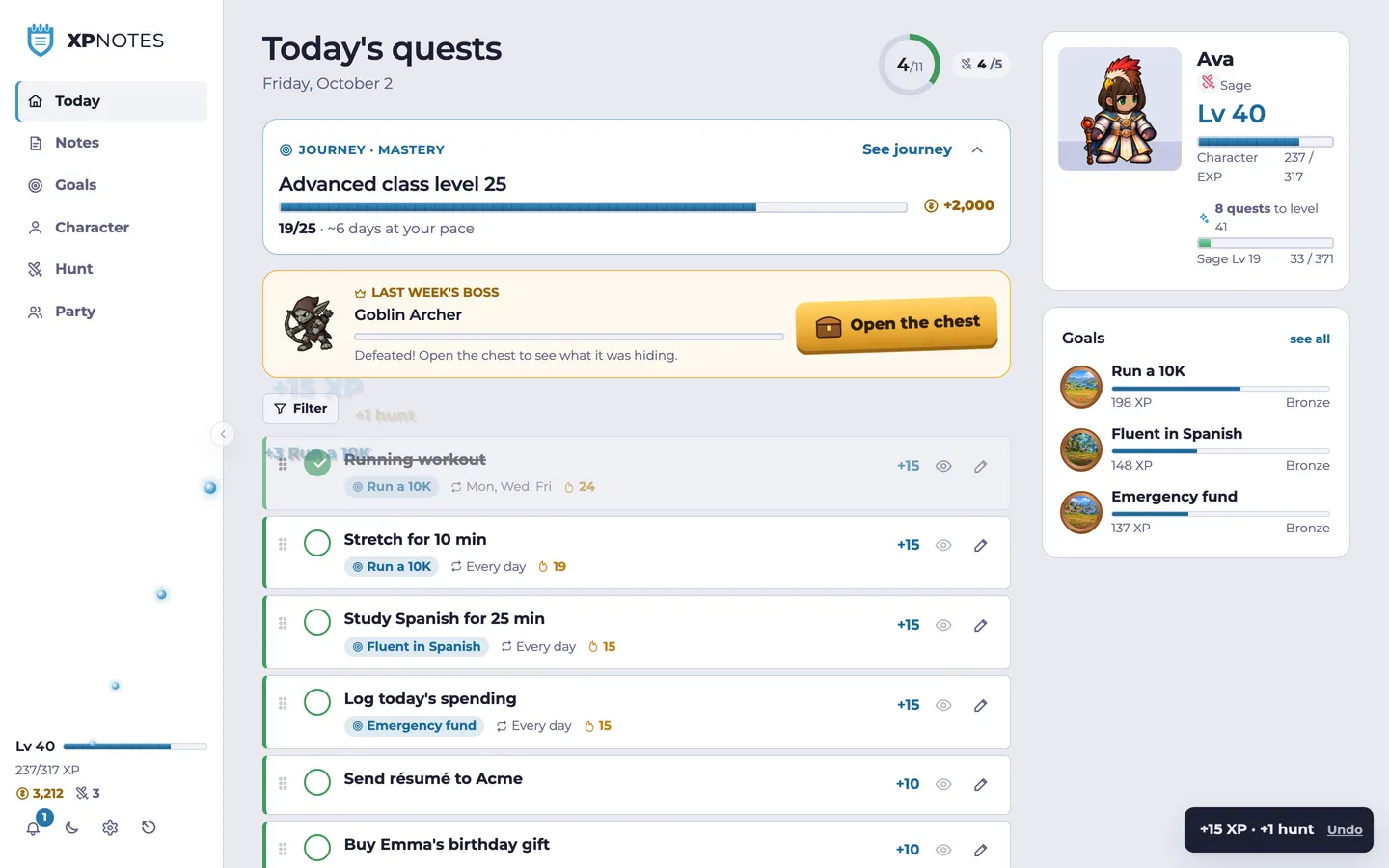
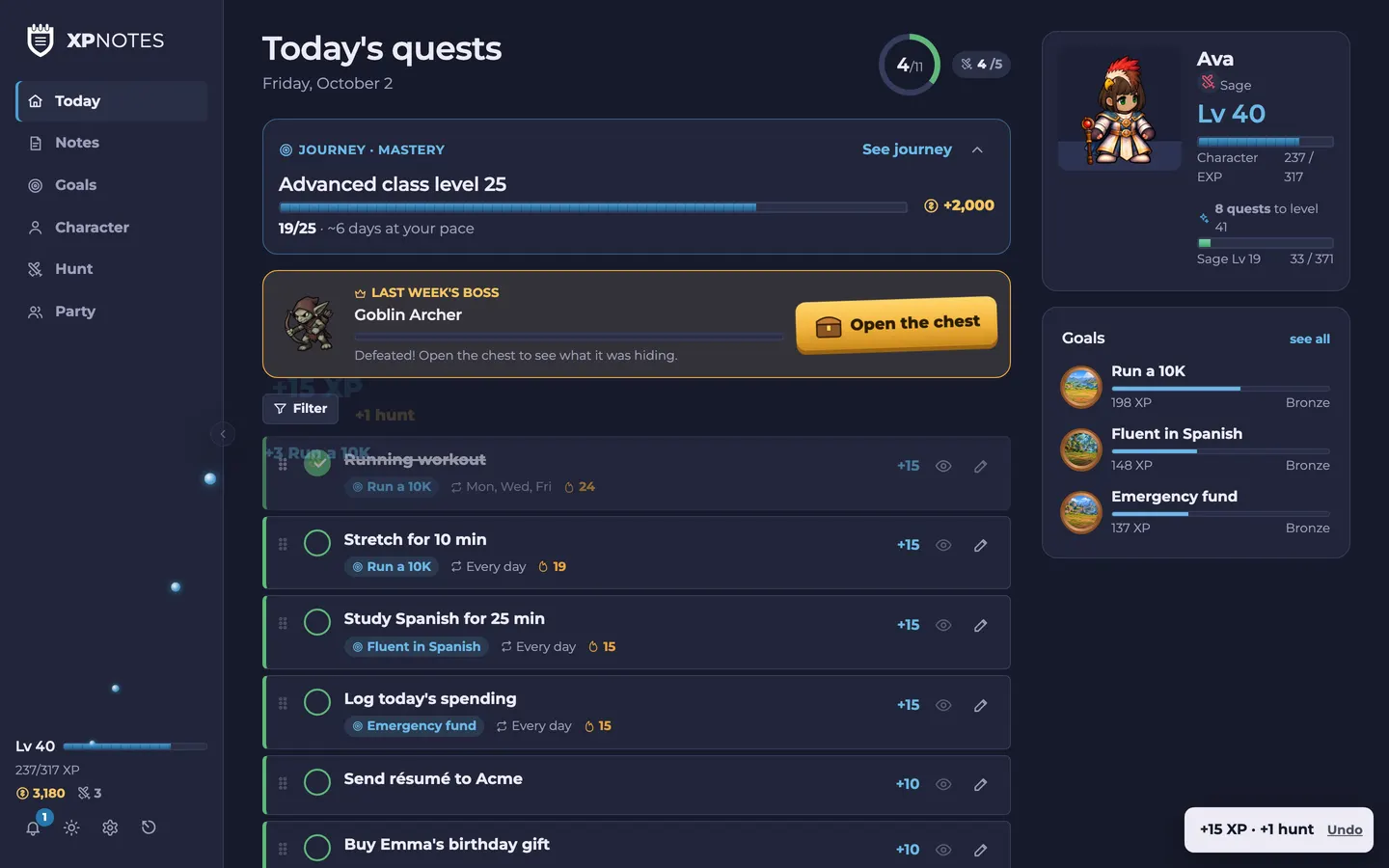
The core principle is simple: the game only moves when your life moves. Nothing in the app rewards spending more time in it. You can see the whole logic in How XPNotes works and on the features page.
Where gamification fails (and how to avoid it)
- Scoring everything. If every gesture earns points, the system becomes paperwork. Score only what matters for your goals.
- Competing for the sake of it. Comparing yourself to others demotivates quickly. Compare yourself to you two weeks ago.
- Swapping the goal for the game. The level is a means, not an end. If you are leveling up but your life goal has stalled, review the quests.
- Ignoring rest. A day off is part of the campaign. A system that punishes every pause is fragile.
- Expecting novelty to last. As reviews suggest, the initial charm fades. Plan a weekly review to keep the system alive.
If you play MMORPGs, also read how to play without putting your life on hold: gamifying your life and playing for real can coexist, as long as each has its space.
Paper, spreadsheet or app?
Any of them works if you use it. What changes is the friction:
| Option | Strength | Weakness |
|---|---|---|
| Notebook or whiteboard | Zero distraction, total freedom | No reminders, easy to abandon |
| Spreadsheet | Flexible, you control the rules | You build the math and the screen; little celebration |
| Game app like XPNotes | Rules, XP, reminders and celebration ready | You accept the app's rules |
If you want to try it with no commitment, start free and see whether your day gains rhythm. Plans are on the pricing page.
Summary: where to start today
- Write one life goal in a single sentence.
- Create three small quests linked to it.
- Decide when you will open the list tomorrow.
- Complete one quest and celebrate.
- At the end of the week, adjust what did not work.
That is gamifying your life: turning what you already want into a game with clear rules, where every step counts.
Frequently asked questions
Does gamifying your life really work?
It often helps, but it depends on context and on the person. Research reviews point to positive, usually small to moderate effects and warn about novelty fading. Use it as support for consistency, not as a magic fix.
Do I need an app to gamify my life?
No. A notebook, spreadsheet or whiteboard works. An app just lowers friction: rules, XP, reminders and celebration come ready, which helps if you tend to forget things.
How many quests per day are ideal?
Few and concrete. Start with three and add more only if it feels easy. More quests do not mean more progress; what counts is finishing what matters for your goal.
What is the difference between gamification and playing video games?
Gamification uses game elements (quests, points, levels) to support real actions away from the screen. Playing a video game is the activity itself. Both can live in the same routine.
What if I lose motivation for the system?
Shrink the quests, review what feels heavy this week and go back to the goal that gives it all meaning. Isolated missed days do not usually derail habit formation; what matters is picking it back up.
Sources
- From game design elements to gamefulness: defining gamification
- Does gamification work? A literature review of empirical studies on gamification
- The gamification of learning: a meta-analysis
- Self-determination theory and the facilitation of intrinsic motivation, social development, and well-being
- Building a practically useful theory of goal setting and task motivation
- Implementation intentions and goal achievement: a meta-analysis of effects and processes
- How are habits formed: modelling habit formation in the real world
Turn your goals into quests
Build your campaign in XPNotes and earn XP for what you actually do. The Free plan is complete.
Start free